5 Steps to Navigating Complexity More Resourcefully

Complexity is the domain in which outcomes are unpredictable and cause and effect are only clear in hindsight. It's the territory of uncertainty — where the old rules don't quite apply, where trying harder doesn't necessarily help, and where the most resourceful response is often counterintuitive.
We encounter complexity everywhere: in organisations navigating rapid change, in leadership challenges that resist simple solutions, in personal situations where the way forward isn't clear. And when complexity triggers us — as it reliably does — we tend to default to old habits rather than respond with the creativity and presence the situation actually calls for.
The following five steps can help you become more practiced at navigating complexity in the most effective way possible. If you'd like to understand more about the nature of complexity itself first, my companion article The Cynefin Framework: A Leader's Guide to Understanding Complexity is a good place to start.
A Note on the Cynefin Framework
The steps below are grounded in the Cynefin framework, developed by Dave Snowden — a sense-making tool that helps us understand the nature of the challenges we face. Complexity is one of four domains in the framework, and it's the one in which emotions tend to explode. Issues in this space are fraught with uncertainty, and our natural responses — fight, flight or freeze — can manifest as anxiety, frustration, hopelessness or despair.
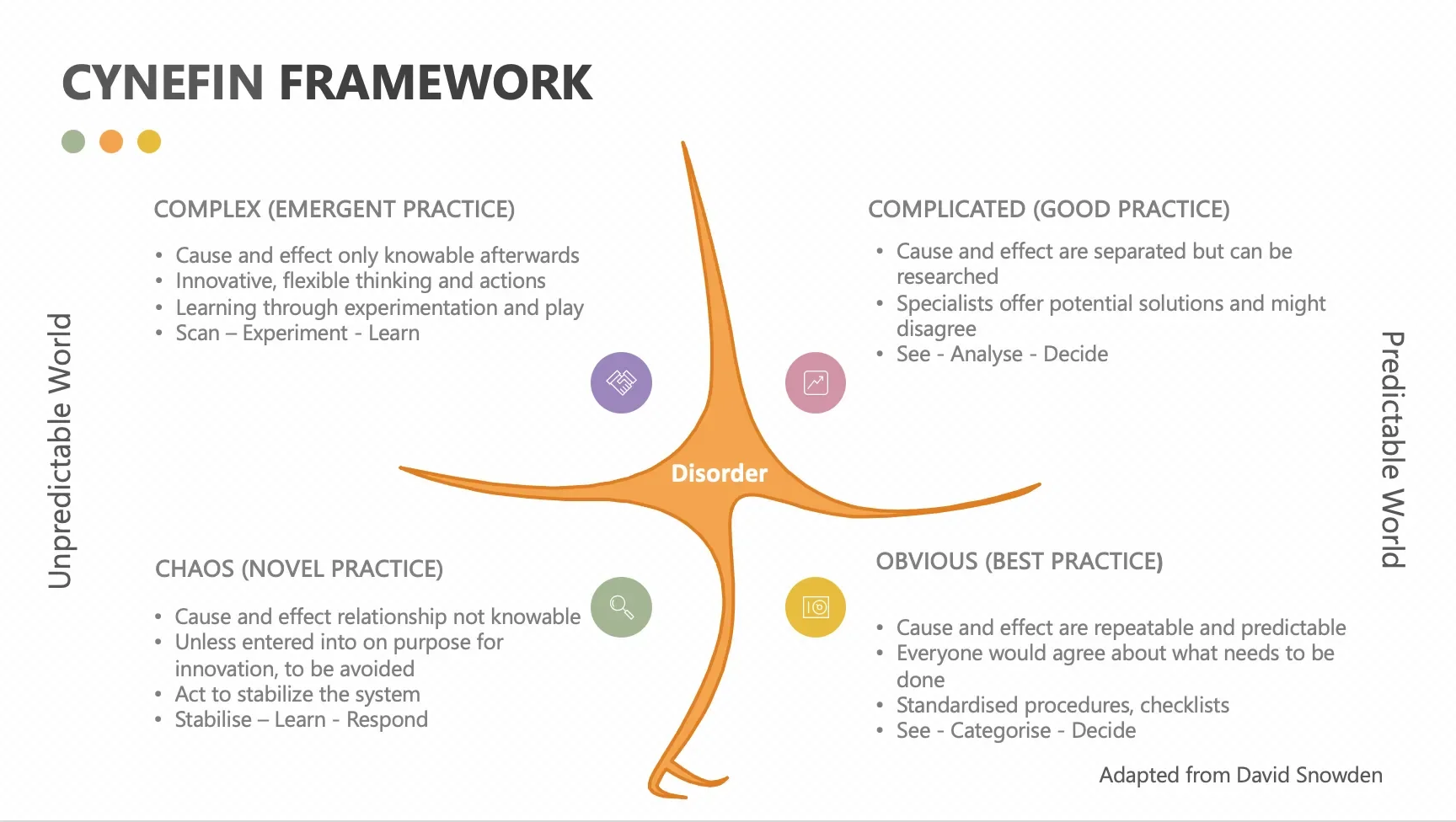
Step 1: See Complexity Objectively
Try to consider the big picture. Just being able to see what you're dealing with objectively changes the nature of the problem — effectively, you are no longer subject to it.
By creating a small distance from the issue — describing it, naming it, categorising it — you begin to give yourself the space to respond rather than react. This shift from subjective to objective is deceptively simple and genuinely powerful.
Step 2: Notice How Complexity "Out There" Triggers You "In Here"
We can't change what we're not aware of. So it's vital to start noticing how you are affected by what's happening — not with a vague label like "I'm feeling stressed," but with real granularity.
What emotion is actually present? What thoughts go with it? What behaviours does it predispose you toward? This matters because emotions shape how we think and act. If we're not paying close attention, we can find ourselves at the mercy of our emotional state rather than in the driving seat.
Step 3: Develop a Physical Awareness
Our emotions don't just live in our minds — they live in our bodies. Notice how a particular emotional state plays out physically.
Do you feel a tightening in your throat when facing an uncertain outcome? Does your breathing become shallow when a difficult conversation approaches? Is there a contraction in your jaw or shoulders when pressure escalates?
These physical cues are early warning signals — reliable indicators that you may be moving in an unhelpful direction. Learning to read them gives you the opportunity to intervene before reactivity takes over.
Step 4: Ground Yourself
As presence-based coach Bebe Hanson puts it:
"Our actions arise from our inner state. If our inner state is triggered and reactive, that's going to create certain actions. If our inner state is grounded, and we are 'in presence' and feel settled and resilient, we're going to produce different actions."
The more grounded you are, the more resourceful you become. You cannot always change your environment — but you can change how you respond to it. And your response plays a significant part in shaping what comes next.
A short centering practice — adapted from leadership embodiment coach Wendy Palmer — can help. She calls it the lizard push-up and it's not only a grounding practice but a small experiment in how shifting your internal state can shift your perception. Why not give it a try?
Step 5: Create the Right Conditions for Good Things to Emerge
In complexity, there is no fixed destination. All we can do is create the best possible conditions for things to move in the right direction. Here's how:
Map out the behaviours, thoughts and patterns you want more of — and less of. Keep returning to these.
Stay present. Learn to centre yourself when you become triggered so you can remain in contact with what's actually happening.
Experiment and learn. Rather than focusing on outcomes, notice what isn't working and try something different. Keep experiments small, clear and short-term.
Start at the edges, not the heart of the issue. See what you can enable and grow what works.
Think differently. Notice when you're drawn to habitual solutions. Be a little wacky. Come up with ideas that make you slightly nervous. Have a little play.
Amplify what works. Dampen down or stop what doesn't.
Cultivate both stability and fluidity. In complexity, balance is critical.
Build connection — to yourself and to others. Trust allows people to be both fluid and dependable.
Practical Ways to Create Stability
Include a centering or grounding practice in your day
Create rituals — team check-ins, a gratitude practice, a regular family dinner
Put routines in place that give structure to uncertain times
Map out the behaviours and patterns you want more of and less of — and measure yourself against them regularly
Practical Ways to Create Fluidity
Move your body — walk, dance, take the stairs
Change your environment — a walking meeting instead of a Zoom call
Try alternate nostril breathing to energise and focus:
Sit comfortably, left arm resting on your lap
Make a peace sign with your right hand and place your two extended fingers on the bridge of your nose
Place your thumb on your right nostril
Close your right nostril and breathe in through the left for 4 seconds
Close your left nostril with your ring and little finger and breathe out for 4 seconds
Alternate nostrils and repeat 5-10 times
Please stop if you feel faint or dizzy.
Creating Connection
Have conversations that aren't about tasks and logistics — but about how people are actually doing. Ask:
"What are you learning about yourself as we navigate this?"
"What is most difficult for you right now?"
"What would make this easier?"
"What could we do right now that would make a difference?"
"Is there anything positive that's come out of this challenge for you?"
Ask yourself these same questions.
In Summary
We can't always change our circumstances — but we can change how we respond to them. Seeing complexity for what it is, and learning to respond rather than react, takes practice. But it is entirely possible. And the more we develop this capacity, the more we give ourselves the chance to shape the kind of future we actually want.
If navigating complexity — in your leadership, your work or your personal life — is something you'd like support with, I'd love to have a conversation.
Find out more about leadership coaching here or life coaching here — or simply get in touch for a complimentary chemistry session.