Rumination vs Reflection: How to Tell the Difference and Stop Overthinking
Updated June 2026
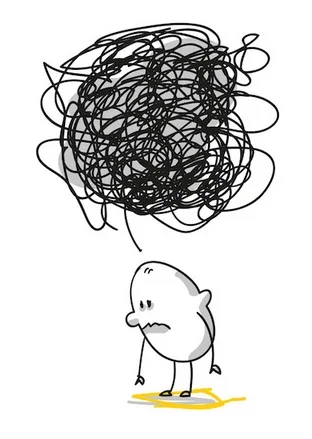
You've been thinking about the same situation for hours. Maybe it's a difficult conversation, a decision you regret, or a conflict that won't resolve itself. You tell yourself you're just trying to work it out — but somehow, the more you think, the worse you feel. Sound familiar? If so, you may be ruminating rather than reflecting. The two can feel deceptively similar, but their effects on your mental health are worlds apart. Here's how to tell the difference — and what to do about it.
“Rumination refers to the tendency to repetitively think about the causes, situational factors, and consequences of one's negative emotional experience (Nolen-Hoeksema, 1991). Basically, rumination means that you continuously think about the various aspects of situations that are upsetting.”
- Psychology Today: Problem Solving Gone Wrong
“Reflection: to think carefully, especially about possibilities and options.”
- Cambridge Online Dictionary
Rumination increases likelihood of developing anxiety or depression
A study conducted in 2013 by the University of Liverpool found that traumatic life events are the biggest cause of anxiety and depression — but how a person thinks about these events determines the level of stress they experience.
The study analysed the responses of over 32,000 participants aged 18–85 years. It found that while traumatic life events were the single biggest determinant of anxiety and depression, a person's thinking style was equally significant. Rumination emerged as one of the two key thinking patterns most likely to lead to anxiety and depression.
The good news: it's possible to change your thinking pattern. The first step is developing awareness that you're ruminating — because you can't change what you're not aware of.
How can you tell when reflection turns into rumination?
Learning to identify the difference involves paying close attention to three elements you take with you everywhere: your thoughts, your emotions and your body. These three areas combined make up your 'way of being' in the world.
Let me illustrate with a personal example.
I was doing my daily practice one morning — a quiet time I spend connecting with myself, watching my breathing, noticing what's happening in my body and observing what's coming up for me emotionally. Thoughts about a recent conflict began drifting into my mind. At first I could look at them in a detached, curious way — as if through the glass of a bell jar. I felt calm. My breathing was easy.
Then something shifted. The peace evaporated and was replaced by rising tension. I became aware of anger, resentment and sadness. There was an ache in my throat, my breathing had become shallow, and I noticed a pinching tightness in my lower back. I had slipped from reflection into rumination — and the difference was unmistakable.
Rumination versus Reflection
Here's what those two states looked like for me — you may recognise aspects of your own experience:
Reflection
Thoughts: neutral or curious — "I wonder why she did that?" or "That's interesting"
Emotions: accepting, peaceful, curious
Body: at ease, relaxed breathing, open chest, no tension or hotspots
Rumination
Thoughts: negative and emotionally charged — "It's so unfair", "How dare she?", "I'm going to make her see she's wrong"
Emotions: resentful, sad, stuck
Body: ache in throat, tightness in lower back, shallow breathing, hunched shoulders, churning in stomach and chest
Getting granular like this helped me see how rumination took me from an open-minded, oxytocin-induced state to a closed-minded, cortisol-fuelled one — reducing my ability to think clearly and leaving me at the mercy of my thoughts and emotions.
How to Shift Out of Rumination and Back Into Reflection
Once you've noticed you're ruminating — and awareness really is the first and most important step — here are some practical ways to shift:
1. Change your body first
Because your thoughts, emotions and body are deeply interconnected, changing your physical state is often the fastest way to interrupt rumination. Straighten your posture, take three slow deep breaths, unclench your jaw and relax your shoulders. These small physical shifts signal to your nervous system that you are safe — making it easier to return to a reflective state.
2. Name what's happening
Simply saying to yourself "I'm ruminating right now" creates a moment of distance between you and your thoughts. You become the observer rather than the participant — which is exactly the quality that characterises reflection.
3. Ask a different question
Rumination tends to circle around questions like "Why did this happen to me?" or "What's wrong with me?" — questions with no useful answer. Try replacing them with "What can I learn from this?" or "What would I do differently next time?" — questions that are forward-facing and genuinely answerable.
4. Set a time limit
Give yourself a defined period — say 10 minutes — to think about the situation. When the time is up, consciously redirect your attention to something that requires your presence.
5. Work with a coach
Rumination is one of the most common patterns that brings people to coaching. A coach can help you develop the self-awareness to catch rumination earlier, and the practical tools to shift out of it more quickly and consistently over time.
Ready to Break the Cycle?
If you recognise yourself in this post and find that rumination is affecting your well-being, your work or your relationships, coaching can help. I work with people to develop the self-awareness and practical tools to manage their thinking more effectively — so they can spend less time stuck in their heads and more time living and working the way they want to.
Book a complimentary chemistry session and let's explore whether coaching could help you too.